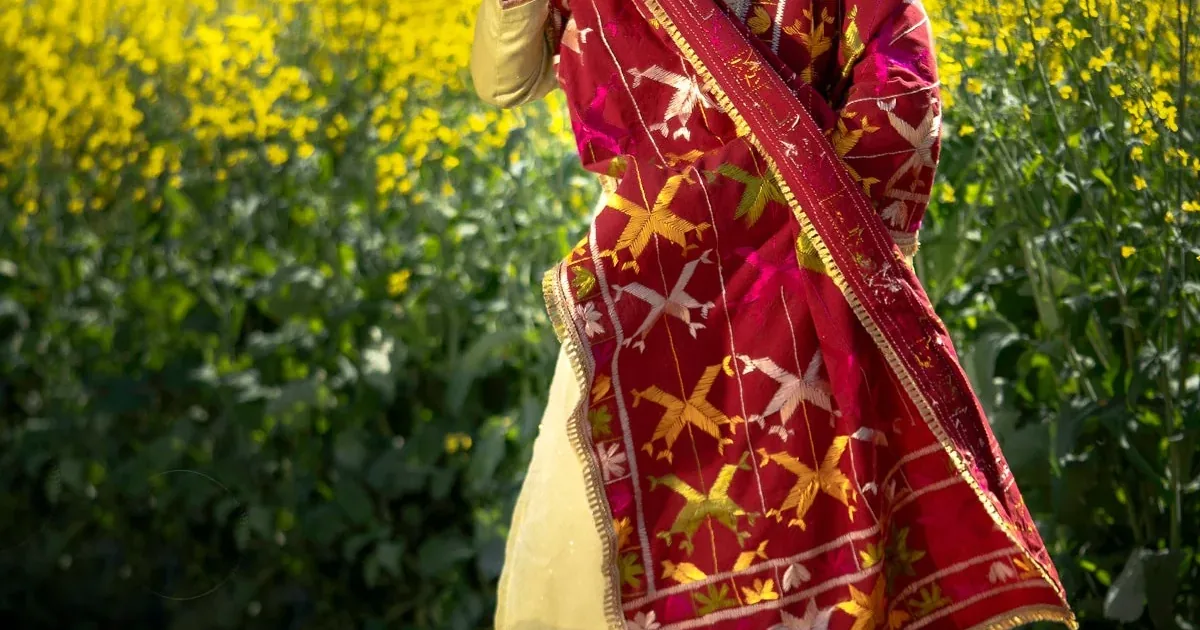
Artisan Spotlight: A Punjab Embroiderer’s Story
Editor’s note: This article is an illustrative portrait of phulkari workshop practice, written to explain the craft. It is not a verbatim interview record: the named person, quoted remarks, and personal details are illustrative rather than documented reporting, and figures are examples, not verified accounts. We will replace it with a documented artisan profile made with the maker’s consent. If you are an artisan who would like to share your story, please contact us.
Picture a morning in a courtyard outside Multan, where an embroiderer is already hours into her stitching. A half-finished dupatta lies stretched across her lap.
As long as it takes, that is the love — that is the spirit of the work.
This is an illustrative portrait of the working life behind phulkari (Punjab’s most famous embroidery): women who learned to stitch young, who have embroidered through decades of rising thread prices and falling demand, and who still refuse to let a machine anywhere near their work.
Learning at Her Mother’s Knee
In this portrait, the embroiderer began stitching at eleven, sitting beside her mother on a charpai, practising the darn stitch (the backbone of phulkari) on scraps of old khaddar.
In many families the teaching is wordless: a wrong row is undone, again and again, until the fingers know before the eyes do.
In phulkari, the stitching is done from the wrong side of the cloth, counting threads, building the design in reverse. It’s embroidery as mathematics. A single misplaced stitch in a bagh (the all-over garden pattern) shows up rows later, and there is no hiding it. Phulkari makers learn to count before they learn to design.
Many begin contributing to the family income in their teens, embroidering dupattas carried to the local bazaar, and later teach younger relatives.
Informal circles of women often stitch together in the afternoons, sharing patterns and thread.
What Phulkari Actually Is
Outsiders often use “phulkari” to mean any Punjabi embroidery. The women who make it are more precise. Getting the vocabulary right matters, because the names describe genuinely different things:
| Term | What it means | Typical use |
|---|---|---|
| Phulkari | “Flower work”, scattered floral motifs on a base cloth | Dupattas, shawls, kurtis |
| Bagh | “Garden”, the entire surface covered in embroidery | Bridal dupattas, heirloom pieces |
| Chope | Embroidered borders with a plain centre field | Wedding shawls |
| Sainchi | Pictorial scenes, trains, wrestlers, village life | Collector pieces, wall hangings |
| Subhar | Festival piece with a central medallion | Ceremonial wear |
A full bagh dupatta can take four to six months of daily stitching.
At the prices middlemen typically offer, the hourly rate can work out to less than a day labourer’s wage. This is the quiet crisis underneath many artisan stories: the work is valued in words and underpaid in rupees.
The Economics Nobody Talks About
As an illustration of how the economics typically break down, take a standard phulkari dupatta of the kind sold in city boutiques for the equivalent of sixty to ninety dollars:
The base khaddar costs about eight dollars.
Thread (good-quality silk floss) costs another six. The stitching time is roughly 200 hours across two months. A middleman may pay the maker the equivalent of twenty-five to thirty dollars in total, while the boutique sells it for three times that. These are example figures, not one maker’s verified accounts.
For many makers, stopping is not an option: this is what their hands know.
What keeps many makers going, beyond necessity, is the circle.
The women pool thread orders to buy in bulk, share large commissions so no one woman is crushed by a deadline, and some have begun selling a few pieces a month directly through social media, cutting out the middleman. Those direct sales can pay substantially more. Direct feedback from buyers is a strong motivator.
How the Circle Protects Quality
Before any piece leaves a circle for a direct buyer, it often goes through a group inspection: every member inspects it in daylight, and any one of them can send it back for rework.
Loose tension, a faded thread batch, a motif that drifts off-count: caught and fixed. It is quality control run on tea and sisterhood.
What She Wants Buyers to Know
For a buyer in Lahore, London, or Toronto about to buy a phulkari piece, the checks are practical:
Turn it over — the back of genuine handwork is almost as neat as the front, while machine copies are messy on the back.
Real khaddar smells like cotton and sun. And ask who made it: if the seller can’t tell you a name, the maker was probably not paid a name’s worth.
Practical care advice: hand-embroidered phulkari should be washed rarely, always by hand, in cool water, and dried in shade. Sun fades the colours, and harsh soap damages them.
Why This Story Matters
I write about techniques on this blog — stitches, threads, tools. But every technique is a person first. Phulkari survived Partition, industrialisation, and the fast-fashion flood not because of museums or hashtags but because women sat down every morning and picked up the needle again.
When you buy a handmade embroidered piece and you know the maker’s name, you are not just buying cloth.
You’re voting, with your wallet, that the next generation of makers gets to choose embroidery rather than being forced into it or out of it.
A single embroidered bookmark — one flower, mustard on maroon, neat on both sides — can take the better part of an hour. It is worth remembering every time you are tempted to call something “just” a bookmark.
Key Takeaways
- Phulkari is stitched from the wrong side by counting threads, a single error compounds across the design, which is why mastery takes years.
- Know the vocabulary: phulkari, bagh, chope, sainchi, and subhar describe genuinely different things.
- A hand-embroidered dupatta represents around 200 hours of skilled work; middlemen typically pay the maker a fraction of the retail price.
- Check the back of the embroidery, neat reverse work is the hallmark of genuine hand stitching.
- Buying directly from artisan circles, where you can learn the maker’s name, can mean the maker keeps a substantially larger share of the price.
- Wash hand-embroidered pieces rarely, by hand in cool water, and dry in shade to protect the colours for decades.
Related guides
Phulkari Embroidery: Complete Technique Guide — for the technique behind the story; Artisan Spotlight: Inside a Block Printing Workshop — for another artisan tradition.
Frequently Asked Questions
How can I tell real hand-embroidered phulkari from machine-made copies?
Turn the piece over. Hand phulkari is nearly as neat on the reverse, with consistent thread tension and no bobbin thread visible. Machine copies show a messier back, perfectly uniform stitches, and often a stabiliser layer. Real khaddar base cloth also has a distinctive hand-loomed texture and smell.
How long does a phulkari dupatta take to make?
A standard scattered-motif dupatta takes roughly 150–200 hours of stitching, usually spread over six to eight weeks. A full-coverage bagh can take four to six months of daily work.
Why is handmade phulkari so much more expensive than bazaar copies?
Because of labour time. Even at very modest hourly rates, 200 hours of skilled handwork costs far more than a machine copy. When you see a suspiciously cheap “hand-embroidered” piece, the maker was almost certainly underpaid — or it is not handmade at all.
How should I care for a phulkari piece?
Hand wash rarely in cool water with mild soap, never wring, dry flat in shade, and store folded in muslin away from direct light. With this care, pieces can last for decades.
Can I commission work directly from artisans?
Increasingly, yes. Many artisan circles now sell through social media or craft platforms. Expect to wait (genuine handwork can’t be rushed), and expect to pay fairly. A direct commission typically costs more than a bazaar piece but ensures the maker receives a proper share.
