Thread Guide: Types, Weights & When to Use Each
Open any experienced embroiderer’s thread drawer and you’ll find a small museum: glossy skeins of stranded cotton, fat pearly balls of perle, fuzzy hanks of crewel wool, a few intimidating metallics still in their packaging.
Open a beginner’s drawer and you’ll usually find one thing, a jumble of stranded cotton in random colours, because nobody told them there were options.
Thread is not a commodity. The thread you choose determines your stitch texture, your fabric compatibility, your frustration level, and in the end how your finished piece looks and ages.
After fifteen years of stitching, here is my complete field guide to embroidery threads: what each type is, how weights work, and exactly when to reach for which.
Understanding Thread Weight
“Weight” in thread doesn’t mean heaviness, it’s a thickness numbering system, and it’s backwards from what you’d guess: higher numbers mean finer thread.
A #8 perle cotton is chunky; a #12 is fine. Stranded cotton sidesteps the system entirely, it comes as six separable strands, and you choose the weight by deciding how many strands to stitch with.
Why it matters: thread weight must suit both your fabric and your stitch. Heavy thread on fine fabric puckers and distorts; fine thread on heavy canvas disappears. The table below is the cheat sheet I wish I’d had on day one.
The Major Thread Types
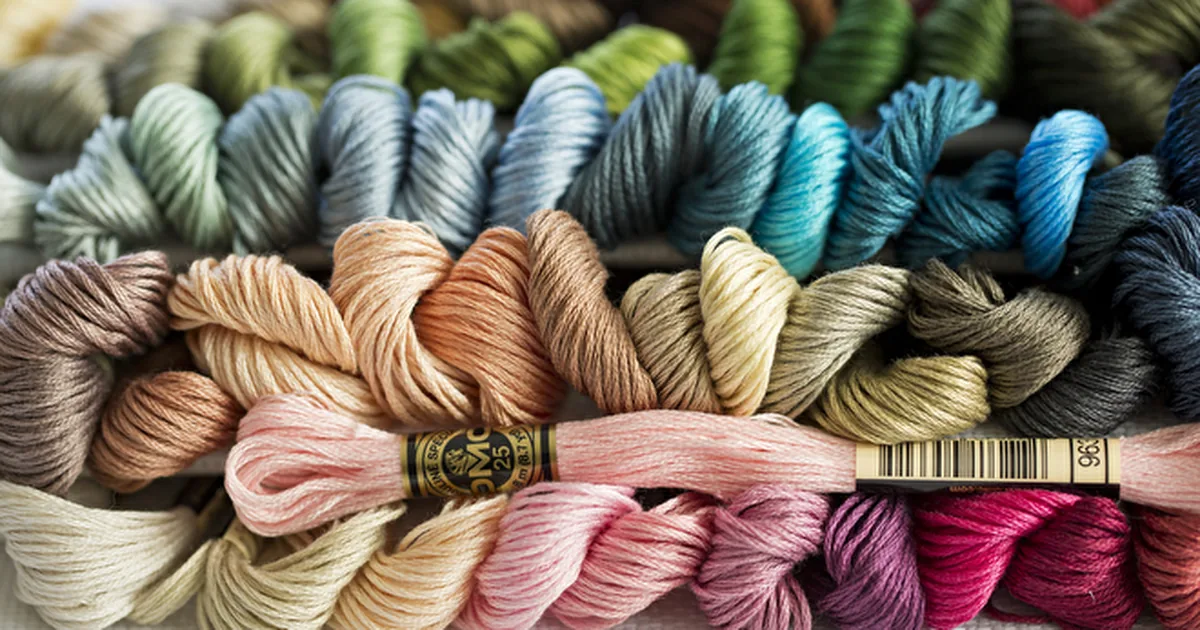
Stranded cotton floss — the universal starter
Six loosely twisted strands in a skein, separable.
This is the thread most people learn on, and with good reason: it’s cheap, comes in hundreds of colours, works on almost any fabric, and the strand-count system gives you infinite weight control — one strand for whisper-fine detail on lawn, all six for bold coverage on denim.
Best for: general surface embroidery, cross-stitch (2 strands on Aida), fine detail work. Watch out for: it tangles if you use lengths over 45cm; it has a slight sheen that some traditional styles avoid; cheap brands have inconsistent dye lots, buy project quantities together.
Perle cotton — the structured pearl
A tightly twisted, non-divisible thread with a beautiful pearlescent sheen, sold in balls or skeins in weights #3 (heavy), #5 (medium), #8 (fine), and #12 (very fine). Because it doesn’t separate, what you buy is what you stitch, wonderfully predictable.
Best for: textured stitches that show off the twist. French knots, bullions, raised chain bands. #5 is my desert-island weight. Watch out for: the tight twist can kink; let the needle dangle periodically to unwind.
Crewel wool — the matte softie
A fine 2-ply wool yarn, traditionally for crewel (Jacobean) embroidery. Matte, soft, slightly fuzzy, it fills shapes with a velvety, painterly texture that cotton can’t imitate.
Best for: crewel work on linen twill, filling large areas, anything where you want softness over shine. Watch out for: wool only — moths love it, so store finished pieces with cedar or lavender; not for items that need frequent washing.
Silk threads — the luxury
Stranded silk floss and twisted silk both exist; both have a luminous depth that makes cotton look flat by comparison. Expensive, occasionally temperamental (silk weakens when wet and can bleed), but unmatched for heirloom pieces.
Best for: bridal and heirloom embroidery, fine shading, pieces that will be handled gently and rarely washed. Watch out for: test every colour for bleeding before committing; store away from light, silk fades faster than cotton.
Metallics — the divas
Metal-wrapped threads for goldwork and accents. Gorgeous, and genuinely difficult: they kink, fray, shred, and punish impatience. Use short lengths (25–30cm max), a large-eyed needle, and expect to go slowly.
Best for: accents, outlines, festive pieces, rarely for large filled areas. Watch out for: almost everything. Couch them (lay and tack down) rather than stitching through fabric when possible; it sidesteps most metallic misery.
Sashiko thread — the workhorse
A matte, tightly twisted cotton in long skeins, designed for running stitch. Strong, minimal sheen, doesn’t tangle easily. Traditionally white/indigo, now available in colours.
Best for: sashiko, visible mending, bold running-stitch designs, denim. Watch out for: it’s too heavy for fine fabrics, this is a medium-to-heavyweight thread.
Specialty threads
Rayon floss (high shine, weak when wet, handle gently), linen thread (rustic matte, wonderful on linen grounds), cotton à broder (a non-divisible matte alternative to perle, lovely for whitework). You don’t need these on day one; you’ll know when a project calls for them.
The Master Comparison Table
| Thread | Weight control | Sheen | Best fabrics | Washability | Cost |
|---|---|---|---|---|---|
| Stranded cotton | 1–6 strands (you choose) | Medium | Almost all | Excellent | $ |
| Perle cotton #5/#8 | Fixed by number | High (pearly) | Medium weaves | Excellent | $$ |
| Crewel wool | 1–3 strands plied | Matte | Linen twill, wool | Hand wash, moth risk | $$ |
| Stranded silk | Separates like cotton | Luminous | Fine silks, lawn | Delicate; may bleed | $$$ |
| Metallic | Fixed | Mirror | Sturdy grounds | Poor — avoid washing | $$$ |
| Sashiko thread | Fixed medium-heavy | Matte | Denim, medium cottons | Excellent | $ |
How Many Strands? A Practical Guide
For stranded cotton and silk, strand count is your weight dial. My defaults, refined over years:
- 1 strand: fine detail on lawn, voile, or silk, tiny French knots, delicate outlines. Requires patience and good light.
- 2 strands: the all-purpose choice for quilting cotton and medium weaves. Most patterns assume 2 strands unless stated.
- 3 strands: bolder lines on medium fabric; good for stems and outlines that need presence.
- 4–6 strands: heavy coverage, filling large shapes on denim or canvas, chunky textured stitches. Above 3 strands, consider laying the strands flat (they twist less and cover better).
Rule of thumb: the thread should fill the needle’s eye without cramming, and a test stitch should sit on the fabric, neither sinking into the weave nor sitting proud like a rope.
Matching Thread to Project: Decision Framework
When starting a project, I run through four questions in order:
- How will it be used and washed? Daily-wear garment → stranded cotton, perle, or sashiko thread. Wall art → anything, including silk and metallics. Baby clothes → soft, washable cotton only.
- What is the fabric? Fine lawn → 1–2 strands or #12 perle. Quilting cotton → 2–3 strands or #8 perle. Denim/canvas → 3–6 strands, #5 perle, or sashiko thread. Match visual weight: heavy thread on light fabric always looks wrong.
- What stitches dominate? Textured knots and raised bands → perle (the twist shows). Smooth satin filling → stranded cotton or silk (lays flat). Long running lines → sashiko thread.
- What mood? Matte and rustic → wool, linen, sashiko. Polished and bright → perle, rayon. Heirloom-luminous → silk.
Storage and Care (Threads Are an Investment)
- Keep skeins wound properly. Pull stranded floss from the end, not the middle, the skein’s label end is designed for tangle-free pulling. Wind working lengths on bobbins or cards.
- Sort by project, store by colour. I keep a “current project” bag and a colour-organised stash. Dye lots vary: for one project, buy all thread at once.
- Protect from light and dust. Sunlight fades thread on the shelf just as it fades it on fabric. Closed boxes, away from windows.
- Wool needs moth defence. Sealed bags with cedar blocks or lavender sachets; inspect yearly.
- Test before you trust. New brand, deep red colour, silk of any kind, stitch a test swatch and wash it before it goes near your project. Thirty minutes of testing has saved me from more disasters than any other habit.
Key Takeaways
- Thread weight is a backwards numbering system (higher = finer); stranded floss gives you manual control via strand count.
- Learn six core threads and their personalities: stranded cotton (versatile), perle (textured sheen), crewel wool (matte softness), silk (heirloom luxury), metallics (difficult divas), sashiko (sturdy matte).
- Match thread weight to fabric weight — heavy thread on fine fabric is the most common beginner error.
- Choose thread by asking four questions: washability needs, fabric, dominant stitches, and desired mood.
- Buy project quantities together (dye lots vary), store away from light, and always test-wash deep colours and silk.
Related guides
Needles, Hoops & Frames: Complete Tool Guide — for the tools to match your thread; Phulkari Embroidery: Complete Technique Guide — for phulkari thread choices.
Frequently Asked Questions
Can I mix different thread types in one project?
Yes, and advanced embroiderers do it constantly for textural contrast (matte wool beside glossy perle is stunning). Just ensure all threads in a washable item are washable, and test-wash the combination first.
Why does my thread keep tangling?
Three usual culprits: lengths over 45cm (cut shorter), pulling from the wrong end of the skein (use the label end), and not letting the twist unwind (let the needle dangle every few minutes). Railroading (stroking stitches flat) also helps.
Is expensive thread really better than cheap thread?
For stranded cotton, mid-range reputable brands are the sweet spot, consistent dyeing, smooth finish, honest yardage. Ultra-cheap floss often has uneven thickness and fugitive dyes. For silk and wool, quality differences are more pronounced and worth paying for.
How much thread do I need for a project?
A standard 8m skein of stranded cotton covers roughly a 10×10cm area of medium-density stitching with 2 strands — very roughly. For a first project, buy one skein per colour plus one spare of your main colour. Running out mid-project and hitting a dye-lot shift is a rite of passage; spares prevent it.
Can I use sewing thread for embroidery?
For tiny, subtle stitching on fine fabric, yes, good-quality sewing thread works for delicate outlines. But it’s much finer than embroidery thread, so coverage is slow, and it lacks the sheen and body designed into embroidery threads. Use the right tool when you can.